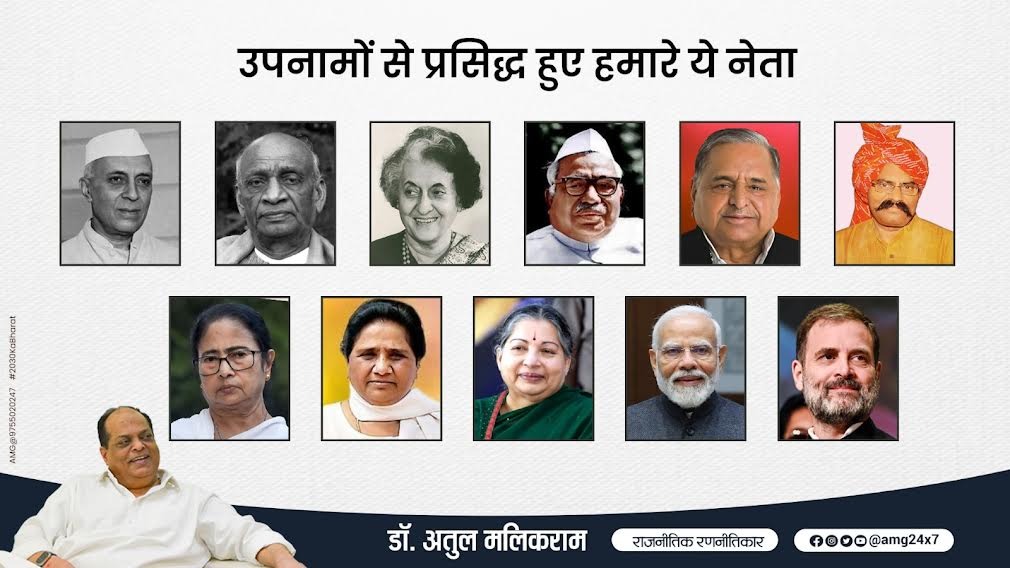
New Delhi — Political strategist Dr Atul Malikram has highlighted how the tradition of assigning nicknames to political leaders in India is far more than a matter of casual address. These names, he notes, emerge from public sentiment, leadership style and historical contributions — becoming symbolic markers of a leader’s identity in the collective consciousness.
According to Dr Malikram, the practice dates back to the pre-Independence era and has continued consistently in modern India. He explains that such monikers often capture the essence of a leader more effectively than any formal title.
Symbols of Affection and Leadership
India’s first Prime Minister, Jawaharlal Nehru, was fondly called Chacha Nehru by children — a name that reflected his warmth, compassion and special rapport with the younger generation. In contrast, the country’s first Deputy Prime Minister, Sardar Vallabhbhai Patel, earned the title Iron Man of India for his unbending resolve and extraordinary role in integrating more than 500 princely states into the Indian Union.
Dr Malikram notes that these nicknames stand as living reminders of the leaders’ defining traits and historic contributions.
Women Leaders and Their Popular Mandate
Nicknames have also shaped the cultural perception of women in Indian politics. Indira Gandhi, India’s first and only woman Prime Minister, became known as the Iron Lady for her decisive leadership during challenging periods, including the Bangladesh Liberation War and the Emergency.
In Tamil Nadu, former Chief Minister J. Jayalalithaa became immortalised as Amma, a title rooted in her welfare-driven governance and widespread public affection. Similarly, West Bengal Chief Minister Mamata Banerjee is popularly referred to as Didi, reflecting her simplicity, grassroots connect and long political struggle.
Identity and Respect in Bahujan Politics
Dr Malikram emphasises that in Bahujan politics, these titles carry even deeper social meaning. Veteran Dalit leader Jagjivan Ram was lovingly known as Babuji, a tribute to his integrity, empathy and principled political life. Former Uttar Pradesh Chief Minister Mayawati is widely addressed as Behenji, a name that positions her as a guardian figure for marginalised communities.

The legacy of Dr Sonelal Patel also finds expression through titles like Mahanayak of the Second Freedom Movement, showing how ideological battles and social justice movements shape political memory.
A Strong Tradition in Socialist Politics
This culture is equally visible in socialist politics. Former Uttar Pradesh Chief Minister Mulayam Singh Yadav earned the moniker Netaji — a reflection of his rise from a grassroots worker to a mass leader commanding widespread respect. Today, Chief Minister Yogi Adityanath is popularly called Bulldozer Baba, a name linked to his zero-tolerance stance on crime and anti-mafia operations.
Nicknames: More Than Names, A Narrative
Dr Malikram notes that political nicknames in India serve as concise narratives — summarising a leader’s ideology, public outreach and leadership style. “These names are not mere labels; they are symbols shaped by emotion, admiration, satire and even political rivalry,” he observes.
While many of these monikers are bestowed lovingly by the public, some originate from media narratives, and others emerge from the opposition in jest or sarcasm — with terms like Feku or Pappu often taking on a life of their own in public discourse.
As Dr Malikram argues, the tradition of political nicknames reflects the vibrancy of Indian democracy, revealing how leaders become larger-than-life figures in the public imagination — not only through their actions but through the names by which they are remembered.